
The instinct when bringing a new pet home is to let the animals sort it out. Put them in the same room, see what happens, intervene if it gets bad. This approach occasionally works. More often it produces a traumatic first encounter that sets the relationship back by weeks or months — because first impressions between animals are not easily overwritten.
The alternative — a slow, structured introduction that keeps animals separated until they've had time to process each other's existence without direct confrontation — feels unnecessarily cautious when both animals seem curious and non-aggressive. It isn't. The time invested in doing introductions slowly is repaid in an established household that functions without ongoing tension.
The principle that applies to every species combination
Animals communicate primarily through scent. Before two animals ever see each other, they can know a great deal about each other through smell — species, sex, age, health, emotional state, whether they're a threat. A well-managed introduction uses this to your advantage by allowing animals to process scent information about each other before visual contact, and visual contact before physical contact.
Rushing past scent and visual stages to physical contact skips the processing that allows an animal to conclude the other is not a threat. That conclusion, once missed, is much harder to reach in the aftermath of a frightening face-to-face encounter.
The stages — separation with scent exchange, visual contact without access, supervised physical contact, unsupervised access — apply whether you're introducing a cat to a cat, a dog to a dog, a cat to a dog, or a small animal to either. The timeline varies; the sequence doesn't.
Cat to cat: the species that requires most patience
Cats are territorial in a way dogs are not. A resident cat has established that your home is its territory. The arrival of another cat is, from its perspective, an intrusion into that territory by an unknown individual. The new cat, meanwhile, is in an unfamiliar environment without established safety. Both animals are stressed before they've even met.
Stage one: complete separation, 3–7 days minimum. The new cat lives in one room with everything they need — litter, food, water, hiding places, a bed. The door stays closed. Resident and newcomer learn each other exists through sounds and the scent that drifts under the door. Feed both cats on opposite sides of the closed door so they begin to associate the other's scent with something positive.
After a few days, swap bedding between the two cats — put the new cat's blanket where the resident cat sleeps and vice versa. This gives each cat concentrated access to the other's scent without any pressure.
Stage two: visual contact, 2–5 days. Use a baby gate, crack the door, or use a glass door if you have one. They can see each other without physical access. Keep these sessions short — ten to fifteen minutes — and end them before either cat becomes stressed or agitated. Continue feeding near the barrier to build positive associations.
Stage three: supervised physical access. Let them share space under supervision. Don't intervene in mild hissing or posturing — this is normal communication, not fighting. Intervene if either cat is cornered, if there's sustained aggressive pursuit, or if contact escalates to biting or sustained fighting.
Some cats take weeks to reach the point of comfortable cohabitation. Rushing any stage because it seems to be going well is the most common mistake. The process is working when both cats can be in the same room without sustained tension, even if they're not interacting warmly.
Dog to dog: neutral territory first
Dogs do better with introductions on neutral ground than at home. The resident dog's territorial instincts are reduced significantly when the meeting happens somewhere neither dog has a claim to — a park, a quiet street, a friend's garden.
Arrange a parallel walk before any face-to-face meeting: both dogs walking in the same direction, far enough apart that they're aware of each other without direct focus — easier to manage if you've already chosen a breed whose energy level suits your daily schedule. Close the gap gradually over the walk as body language allows. Signs that both dogs are comfortable: loose body posture, relaxed tails, interested sniffing of the environment rather than fixated staring at each other. Signs to slow down: stiff posture, sustained direct stare, hackles raised, excessive pulling toward or away from the other dog.
Face-to-face greeting should be brief initially — sniff, then move on. Multiple short greetings are better than one prolonged one. Let the interaction build naturally.
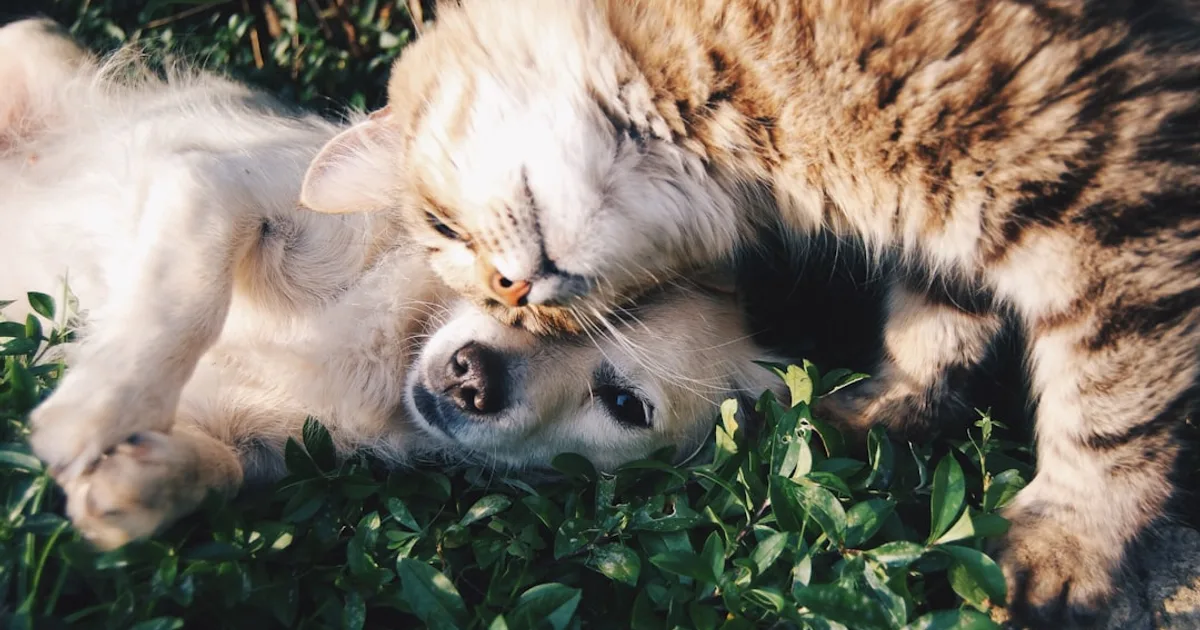
When bringing a new dog home for the first time, do the neutral territory meeting before entering the house. Coming home together rather than the new dog arriving to find a resident dog already there reduces territorial friction.
At home, manage resources for the first few weeks. Separate feeding stations, multiple water bowls, multiple beds — and, for cats, a diet with adequate moisture that reduces stress-related urinary issues during transitions. Resource guarding — protecting food, toys, or resting spots — is a common trigger for conflict between dogs who otherwise get on fine. Remove the competition by ensuring there's no scarcity.
Cat and dog: managing the power imbalance
A cat and dog introduction has an extra complication: the prey drive that many dogs carry and the vulnerability that puts the cat in. Even a dog with no aggressive intent toward the cat can trigger a fear response through size, sudden movement, or enthusiastic approach. A frightened cat that runs triggers chase behaviour even in dogs that don't want to harm the cat.
The cat needs high spaces and escape routes that the dog cannot access — the same vertical territory that indoor enrichment toys and cat trees provide. Before the introduction process begins, establish that the cat has places in every room — shelves, cat trees, furniture the dog can't get on — where they can be above the situation. A cat that can retreat upward and observe from safety is far less stressed than one that has to pass the dog to reach a hiding place.

Follow the same separation and scent exchange process as cat-to-cat introductions. When visual access begins, the dog must be on a leash. The goal is calm, disinterested behaviour from the dog — teach "leave it" if you haven't already, and practice it before these sessions. A dog that can be redirected from cat focus is manageable. A dog in an uncontrollable prey-drive state around a cat is a safety issue before it's a training issue.
Progress at the cat's pace, not the dog's. The dog's curiosity is usually evident quickly. The cat's comfort takes longer and is the limiting factor. An introduction where the cat voluntarily approaches or sits near the dog at floor level is a genuine milestone worth waiting for.
Small animals: a different category of risk
Rabbits, guinea pigs, hamsters, birds, and reptiles in a household with cats or dogs occupy a different risk category. The predator-prey dynamic is real, instinctive, and not fully trainable away in most animals.
Supervised access is possible in some combinations — a confident, large rabbit and a calm, low-prey-drive dog can coexist under supervision, for example. But the small animal should always have an enclosure that is physically impossible for the cat or dog to breach, and should never be left unsupervised with a predator species regardless of how well the supervised interactions have gone.
The timeline reality
A cat-to-cat introduction done properly takes three to six weeks before both cats are comfortable. Some take longer. A dog-to-dog introduction can go faster — a week to ten days of careful management before reasonably unsupervised access is not unusual for compatible dogs.
What undermines timelines most consistently is someone in the household shortcutting the process because the animals seemed fine. Seeming fine in controlled, brief, supervised sessions is not the same as being genuinely comfortable. Let the animals' behaviour lead — the timeline is done when both animals are relaxed in each other's presence, not when a fixed number of days have passed.
The household that results from a slow introduction — animals that have genuinely processed each other and established a functional relationship — is a different environment to one where the animals were forced together and have spent years managing a tension that never fully resolved, much like the patience required when you talk to teenagers without arguments rather than forcing a resolution. The weeks of patience at the start determine which household you end up with.


